

How to Make Relocating for Work Easier

Deciding to take the plunge and relocate abroad is a huge, often stressful decision for any candidate whose application for job in a foreign country has been successful.
To help reduce the challenge, we’ve created this guide to simplifying the relocation process and detail what every candidate should consider when making the move. Such advice is becoming ever more important as relocating is becoming increasingly attractive to workers: 62% agree they would relocate for a job, especially 76% of professionals aged 18 to 34.
6 things to consider when relocating

Benefits
Before accepting the job offer, determine the basics: what is your new salary? Will your position change? Will you be able to cover the costs of relocating if the new employer won’t contribute? Also consider your personal development: will the relocation improve your skills? Will it help you improve your career prospects and grow professionally?
Advice from others
Don’t weigh up the pros and cons by yourself only – be sure to talk to trusted colleagues in your existing company or with people who have already been through the relocation process. Ask them for advice and tips so you benefit from unbiased views of what to expect. Asking friends and family for advice is not recommended because they can struggle with the idea of you moving away, which can in turn cloud their judgement.
Relationships
When you have a partner – and even children – you will probably not be able to make the move on your own. While you will have an organised life in the new country from day one, your partner will be thrown into a new environment and will need to learn to fit in – and that’s a big ask.
Research shows that they will understandably be preoccupied with organising family life, finding a job and learning a new language and culture. Combined, this can lead them to feeling isolated – so, before any decision is made, it is imperative that your partner’s happiness is put front and centre alongside your own.
Additionally, take a look at the neighbourhood where you plan to live and research the quality of schools there. If there are no good schools nearby, consider picking another location with a good school rather than expecting your child to commute to one that is far away.
Psychological and personal resources that are found to improve coping with the challenges and stresses of relocating are:
- An open mind and emotional stability
- Maintaining contact with the extended family, friends or former colleagues
- A family that is flexible, able to adapt and is cohesive
- Good relationships within the family.
If this sounds like your family, then great! You are already well suited to facing the challenges of making that move.
First impression
Try and get an idea of what the work and the new location are like by asking for a temporary stint or job-swap to test it. Companies are increasingly willing to arrange such short-term moves as they want to make sure you’ll fit into your new job and not go home after a month.
When you first arrive at your new residence and place of work, try to build a network from day one as well. Even if you are satisfied with the work, it’s critical to become part of a strong and thriving professional community. One way to achieve this is to make a habit of saying ‘yes’ to all social events and taking part in office social gatherings so you can get to know as many people as possible.
Backup Plan
Of course, relocation doesn’t always work out so make sure you have a safety net in place if the job doesn’t turn out to be the opportunity you hoped it would be. It’s best to talk to your partner about how long you will give the job before potentially throwing in towel, creating an exit strategy if necessary.
Relocation Costs
Depending on the company’s budget, it may give you a padded offer, a specific reimbursement amount, or even a signing bonus for relocating. Although companies do not have to provide you with any compensation, 34% of companies have already increased their relocation packages providing financial and other types of assistance to relieve the employee of the upcoming costs. However, 30% of organisations don’t offer any incentives for moving – so you’ll need to prepare for any associated costs.
First, you should create a relocation budget, which is essential for managing all the upcoming expenses. Divide the costs into two categories: the cost of the relocation and the cost of living once you’ve settled in. The relocation costs may include packing materials and van rental; hiring professional movers or shipping fees; utility deposits at the new place and remaining balances at your old place; and a security deposit for the new accommodation if renting, or temporary short-term housing if buying.
Of course, relocation costs vary from country to country. The most expensive city to relocate to is San Francisco according to a study from the moving company Movinga. To relocate there, the first three months typically cost over £11,000; relocating with your family doubles that figure to nearly £20,000. Keep in mind that these figures do not include the cost of flights!

The most expensive European city to relocate to is Geneva, Switzerland, where you pay nearly £10k when relocating alone or over £16k when taking your family with you. On average, moving with a family is twice as expensive as moving alone.
Living costs in Europe

You should also consider the cost of living in the country itself. Costs include mortgage or rent payment for the new home, monthly utility costs, transportation, new furniture and decorations, and more. Additionally, you will need to pay for repairs and ongoing maintenance if you’re buying a home, and everyday costs such as groceries and car insurance.
After Switzerland, the most expensive countries to live in Europe are Iceland and Norway. In an index that compares the average living costs with those in New York City, these three countries are 13-31% more expensive than their US counterpart. As a comparison, living in the UK or in Germany is 25% cheaper than living in NYC. The countries with half the cost of living compared to New York City are Slovakia and the Czech Republic, while the country with the lowest costs is Ukraine, where you only pay 25% of what you would in NYC.
This all means you should ensure your new salary can meet the predicted costs of living in the new country; a massive salary in a country where the cost of living is double to what you’re used to might not be that massive after all. Also, keep in mind the tax levels in your new country:
Tax implementation

To cover the costs, work out your net income after relocating. Although each country has its own definition of tax residence, you will usually be considered a tax resident in the country that you spend more than six months a year in. Additionally, you will normally remain a tax resident in your home country as well when spending less than six months a year in another EU country.
Of course, when relocating, both countries may consider you a tax resident at the same time – so both could require you to pay taxes on your income. Fortunately, many countries already have double tax agreements in place and usually provide clear rules to determine which country will treat you as a resident. If you are unclear about your position, contact the tax authorities in both countries for clarification.
Taxes for expatriates and jobseekers
In some cases – such as for workers posted abroad for a limited period or jobseekers abroad – you may be regarded as a resident for tax purposes in your home country and therefore liable for tax, even if your stay abroad lasts longer than six months.
This will be the case if you retain your permanent residence in your home country and where your economic ties with that country are stronger. If you have your permanent home or ‘domicile’ outside the UK, you may not have to pay UK tax on the income you make in the foreign country. Again, check with the relevant tax authorities to find out which rules apply to you. In such cases, your host country may also tax you and your local employer may withhold tax on your salary.
In addition, whether or not you remain resident in your home country for tax purposes, another country may tax income (e.g. from assets) generated there. In these cases, be aware that you may be able to avoid double taxation so again check with your relevant tax authorities.
In the EU, there is equal treatment – no matter which EU country you are considered a tax resident, you should be taxed the same way as the nationals of that country and under the same conditions. Additionally, you will be entitled to any UK family allowances and tax deductions for childcare costs, even if the costs are incurred in another EU country, plus any available tax deductions for interest on mortgages as well as a joint tax assessment with your spouse.
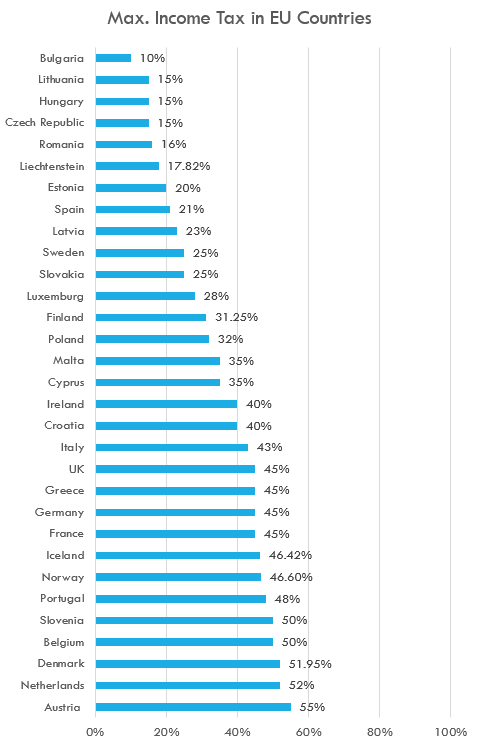
Income taxes have to be paid in every country with the chart above detailing the maximum level of income tax you will have to pay in each EU country. Remember that these are the maximum tax rates and limits are different in each country: in Austria, for instance, the maximum tax rate is only applied to an annual income of €1,000,000.00, while in Belgium, you will have to pay the maximum tax rate of 50% when earning €38,830.00 or above. For each country, you can look up the exact tax policy here. Depending on the country, you might have to add municipal taxes, church tax, surcharges, etc. as well.
Make the move
If you are looking for a new job opportunity and are open to relocation, contact global recruitment agency Tunnicliffe Hunt here who can guide you through the process and ensure when you do arrive in that new country, you’ll know exactly what to expect.
